> ## Documentation Index
> Fetch the complete documentation index at: https://docs.orum.io/llms.txt
> Use this file to discover all available pages before exploring further.
# Webhook Best Practices
> Best practices for implementing secure and reliable webhooks.
## Security Best Practices
### Verify Webhook Signatures
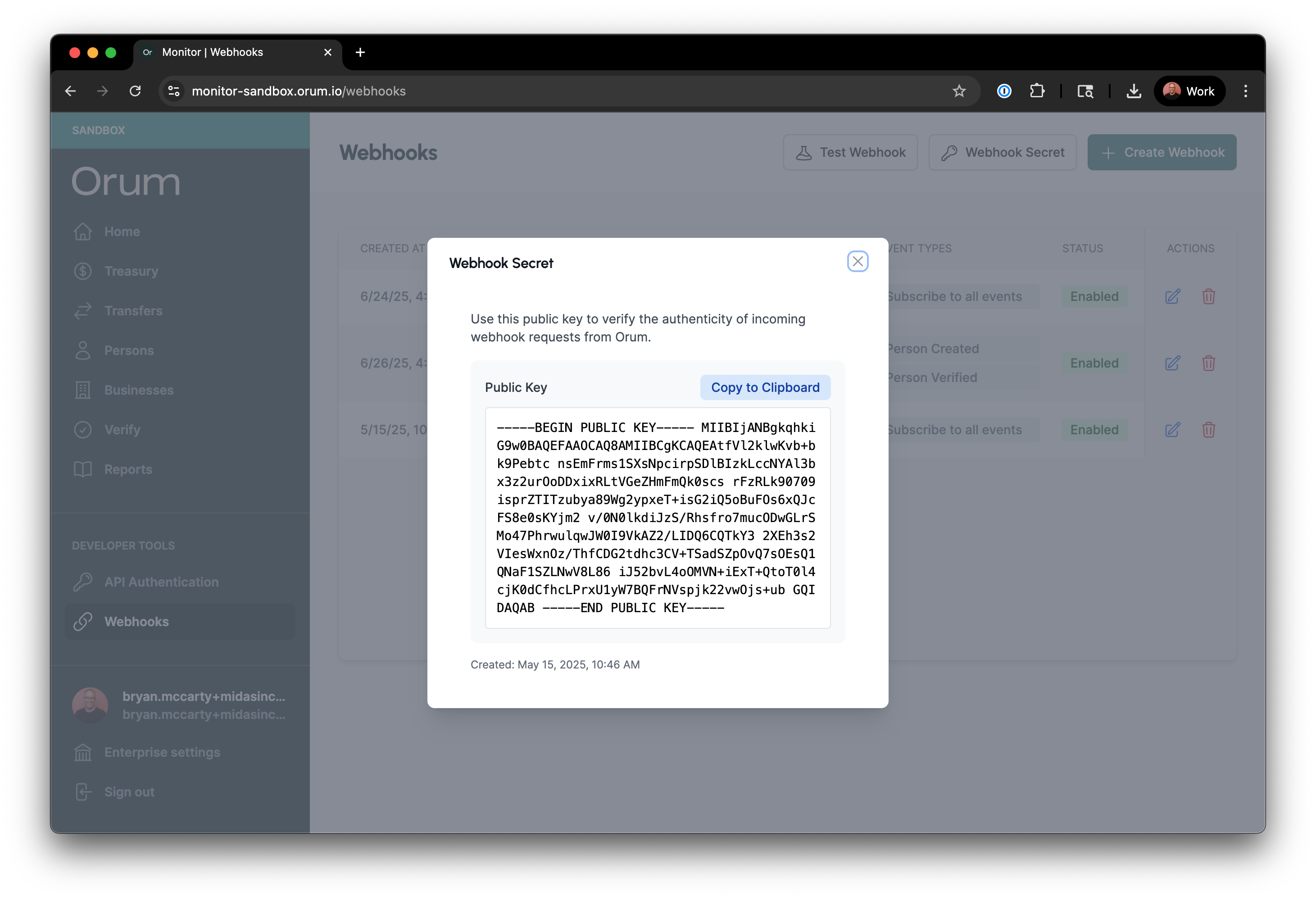
In Monitor, click **"Webhook Secret"** to copy the public key you'll need to verify incoming webhook signatures.
 **Verify every webhook signature** before processing:
```python theme={null}
# Python example
import base64
from Crypto.PublicKey import RSA
from Crypto.Hash import SHA256
from Crypto.Signature import pkcs1_15
def verify_webhook_signature(request_body, created_at, signature, public_key):
try:
# Concatenate body + timestamp
message = request_body + created_at
# Create hash
hash_obj = SHA256.new(message.encode())
# Verify signature
key = RSA.import_key(public_key)
pkcs1_15.new(key).verify(hash_obj, base64.b64decode(signature))
return True
except Exception:
return False
```
**Reject invalid signatures immediately:**
```python theme={null}
def process_webhook(request):
if not verify_webhook_signature(
request.body,
request.json['created_at'],
request.headers['Signature'],
public_key
):
return {"error": "Invalid signature"}, 401
# Process valid webhook
return process_event(request.json)
```
### Network Security
**Restrict Access by IP Address:**
Configure your firewall to only accept webhooks from Orum's IP addresses:
```text theme={null}
Sandbox: 34.232.246.7
Production: 34.231.148.64, 3.234.102.51, 54.221.230.177
```
**Use HTTPS Only:**
* Always use HTTPS URLs for webhook endpoints
* Ensure valid SSL certificates
* Regularly renew SSL certificates before expiration
**Avoid Authentication Requirements:**
* Don't require API keys or authentication tokens
* Webhook endpoints should be publicly accessible
* Use signature verification instead of authentication
## Reliability Best Practices
### Implement Idempotent Processing
**Handle Duplicate Events Gracefully:**
Orum may retry webhook deliveries, so implement idempotent processing:
```python theme={null}
def process_webhook_event(event_data):
event_id = event_data['event_id']
# Check if event was already processed
if is_event_processed(event_id):
return {"status": "already_processed"}, 200
# Process the event
result = handle_event(event_data)
# Mark event as processed
mark_event_processed(event_id)
return {"status": "success"}, 200
```
**Use Event IDs for Deduplication:**
* Store processed event IDs in your database
* Check for duplicates before processing
* Include event ID in your processing logs
### Respond Quickly
**Return HTTP Response Within 30 Seconds:**
```python theme={null}
import asyncio
from concurrent.futures import ThreadPoolExecutor
def webhook_handler(request):
# Respond immediately
event_data = request.json
# Queue for async processing
executor.submit(process_webhook_async, event_data)
return {"status": "received"}, 200
def process_webhook_async(event_data):
# Time-consuming processing happens here
# Database updates, external API calls, etc.
pass
```
**Implement Asynchronous Processing:**
* Use message queues (Redis, RabbitMQ, SQS) for complex processing
* Respond to webhook immediately, process later
* Implement retry logic for failed background processing
### Handle Webhook Failures Gracefully
**Implement Retry Logic for Your Processing:**
```python theme={null}
import time
from functools import wraps
def retry_on_failure(max_retries=3, delay=1):
def decorator(func):
@wraps(func)
def wrapper(*args, **kwargs):
for attempt in range(max_retries):
try:
return func(*args, **kwargs)
except Exception as e:
if attempt == max_retries - 1:
raise e
time.sleep(delay * (2 ** attempt)) # Exponential backoff
return None
return wrapper
return decorator
@retry_on_failure(max_retries=3)
def update_database(event_data):
# Database operation that might fail
pass
```
**Log All Webhook Processing:**
* Log successful and failed webhook processing
* Include event IDs, timestamps, and error details
* Monitor logs for patterns and issues
## Performance Best Practices
### Optimize Webhook Processing
**Minimize Processing Time:**
* Validate webhook signature first
* Perform minimal processing in the webhook handler
* Use background jobs for complex operations
* Cache frequently accessed data
**Example Optimized Handler:**
```python theme={null}
def webhook_handler(request):
start_time = time.time()
# Quick validation
if not verify_signature(request):
return {"error": "Invalid signature"}, 401
event_data = request.json
# Quick database lookup
if is_duplicate_event(event_data['event_id']):
return {"status": "duplicate"}, 200
# Queue for background processing
queue_event_processing(event_data)
# Log processing time
processing_time = time.time() - start_time
logger.info(f"Webhook processed in {processing_time:.3f}s")
return {"status": "queued"}, 200
```
### Scale for High Volume
**Design for Concurrent Processing:**
* Use connection pooling for database connections
* Implement proper error handling for database timeouts
* Consider using read replicas for webhook processing queries
**Monitor Performance Metrics:**
* Track webhook processing times
* Monitor queue depths and processing delays
* Set up alerts for performance degradation
## Event Handling Best Practices
### Subscribe to Relevant Events Only
**Choose Specific Event Types:**
```python theme={null}
# Good: Subscribe to specific events you need
subscribed_events = [
"transfer_updated",
"person_verified",
"business_rejected"
]
# Avoid: Subscribing to all events if you only need a few
```
**Filter Events at Processing Time:**
```python theme={null}
def process_webhook(event_data):
event_type = event_data['event_type']
if event_type == "transfer_updated":
return handle_transfer_update(event_data)
elif event_type == "person_verified":
return handle_person_verification(event_data)
else:
logger.info(f"Ignoring event type: {event_type}")
return {"status": "ignored"}, 200
```
### Handle Event Order Correctly
**Don't Assume Event Order:**
Orum doesn't guarantee webhook delivery order, so design your processing accordingly:
```python theme={null}
def handle_transfer_update(event_data):
transfer = event_data['event_data']['transfer']
transfer_id = transfer['id']
new_status = transfer['status']
updated_at = transfer['updated_at']
# Check if this is the latest update
current_transfer = get_transfer_from_db(transfer_id)
if current_transfer and current_transfer['updated_at'] > updated_at:
logger.info(f"Ignoring older update for transfer {transfer_id}")
return {"status": "outdated"}, 200
# Process the update
update_transfer_status(transfer_id, new_status, updated_at)
return {"status": "processed"}, 200
```
### Implement Proper Error Handling
**Return Appropriate HTTP Status Codes:**
```python theme={null}
def webhook_handler(request):
try:
# Webhook processing logic
result = process_webhook(request.json)
return {"status": "success"}, 200
except ValidationError as e:
# Client error - don't retry
logger.warning(f"Validation error: {e}")
return {"error": "Invalid webhook data"}, 400
except DatabaseConnectionError as e:
# Server error - retry
logger.error(f"Database error: {e}")
return {"error": "Processing error"}, 500
except Exception as e:
# Unknown error - retry
logger.error(f"Unexpected error: {e}")
return {"error": "Internal error"}, 500
```
**Status Code Guidelines:**
* **2xx**: Successfully processed (won't be retried)
* **4xx/5xx**: Failed to process (will be retried)
## Monitoring and Observability
### Set Up Comprehensive Logging
**Log Key Information:**
```python theme={null}
import logging
import json
logger = logging.getLogger('webhook_handler')
def webhook_handler(request):
event_data = request.json
logger.info(
"Webhook received",
extra={
"event_id": event_data.get('event_id'),
"event_type": event_data.get('event_type'),
"timestamp": event_data.get('created_at'),
"source_ip": request.remote_addr
}
)
# Process webhook...
logger.info(
"Webhook processed successfully",
extra={
"event_id": event_data.get('event_id'),
"processing_time": processing_time
}
)
```
### Monitor Webhook Health
**Track Key Metrics:**
* Webhook processing success rate
* Average processing time
* Queue depth (for async processing)
* Error rates by type
**Set Up Alerts:**
* High error rates
* Processing delays
* Signature verification failures
* Endpoint downtime
### Use Monitor Tools
**Leverage Built-in Monitoring:**
* Review delivery logs regularly
* Monitor delivery success rates
* Use test functionality to validate changes
* Check webhook status and configuration
## Development and Testing Best Practices
### Local Development Setup
**Use ngrok for Local Testing:**
```bash theme={null}
# Install ngrok
npm install -g ngrok
# Expose local webhook endpoint
ngrok http 3000
# Use the HTTPS URL for webhook configuration
# https://abc123.ngrok.io/webhook
```
**Test with Realistic Data:**
* Use Monitor test functionality
* Test with various event types you subscribe to
* Verify signature verification works correctly
* Test error scenarios and edge cases
### Staging Environment Testing
**Deploy to Staging First:**
* Test webhook configuration in staging environment
* Use sandbox webhook IP addresses
* Verify all event types are handled correctly
* Test failure scenarios and recovery
**Performance Testing:**
* Load test webhook endpoints
* Verify handling of concurrent requests
* Test with high volume of events
* Monitor resource usage under load
## Production Deployment Checklist
**Security:**
* Webhook signature verification implemented
* HTTPS endpoint with valid SSL certificate
* IP address restrictions configured
* No authentication requirements on webhook endpoint
**Reliability:**
* Idempotent processing implemented
* Response time under 30 seconds
* Proper HTTP status codes returned
* Error handling and logging in place
**Performance:**
* Asynchronous processing for complex operations
* Database connection pooling configured
* Monitoring and alerting set up
* Load testing completed
**Testing:**
* All subscribed event types tested
* Signature verification tested
* Error scenarios tested
* Recovery procedures documented
**Verify every webhook signature** before processing:
```python theme={null}
# Python example
import base64
from Crypto.PublicKey import RSA
from Crypto.Hash import SHA256
from Crypto.Signature import pkcs1_15
def verify_webhook_signature(request_body, created_at, signature, public_key):
try:
# Concatenate body + timestamp
message = request_body + created_at
# Create hash
hash_obj = SHA256.new(message.encode())
# Verify signature
key = RSA.import_key(public_key)
pkcs1_15.new(key).verify(hash_obj, base64.b64decode(signature))
return True
except Exception:
return False
```
**Reject invalid signatures immediately:**
```python theme={null}
def process_webhook(request):
if not verify_webhook_signature(
request.body,
request.json['created_at'],
request.headers['Signature'],
public_key
):
return {"error": "Invalid signature"}, 401
# Process valid webhook
return process_event(request.json)
```
### Network Security
**Restrict Access by IP Address:**
Configure your firewall to only accept webhooks from Orum's IP addresses:
```text theme={null}
Sandbox: 34.232.246.7
Production: 34.231.148.64, 3.234.102.51, 54.221.230.177
```
**Use HTTPS Only:**
* Always use HTTPS URLs for webhook endpoints
* Ensure valid SSL certificates
* Regularly renew SSL certificates before expiration
**Avoid Authentication Requirements:**
* Don't require API keys or authentication tokens
* Webhook endpoints should be publicly accessible
* Use signature verification instead of authentication
## Reliability Best Practices
### Implement Idempotent Processing
**Handle Duplicate Events Gracefully:**
Orum may retry webhook deliveries, so implement idempotent processing:
```python theme={null}
def process_webhook_event(event_data):
event_id = event_data['event_id']
# Check if event was already processed
if is_event_processed(event_id):
return {"status": "already_processed"}, 200
# Process the event
result = handle_event(event_data)
# Mark event as processed
mark_event_processed(event_id)
return {"status": "success"}, 200
```
**Use Event IDs for Deduplication:**
* Store processed event IDs in your database
* Check for duplicates before processing
* Include event ID in your processing logs
### Respond Quickly
**Return HTTP Response Within 30 Seconds:**
```python theme={null}
import asyncio
from concurrent.futures import ThreadPoolExecutor
def webhook_handler(request):
# Respond immediately
event_data = request.json
# Queue for async processing
executor.submit(process_webhook_async, event_data)
return {"status": "received"}, 200
def process_webhook_async(event_data):
# Time-consuming processing happens here
# Database updates, external API calls, etc.
pass
```
**Implement Asynchronous Processing:**
* Use message queues (Redis, RabbitMQ, SQS) for complex processing
* Respond to webhook immediately, process later
* Implement retry logic for failed background processing
### Handle Webhook Failures Gracefully
**Implement Retry Logic for Your Processing:**
```python theme={null}
import time
from functools import wraps
def retry_on_failure(max_retries=3, delay=1):
def decorator(func):
@wraps(func)
def wrapper(*args, **kwargs):
for attempt in range(max_retries):
try:
return func(*args, **kwargs)
except Exception as e:
if attempt == max_retries - 1:
raise e
time.sleep(delay * (2 ** attempt)) # Exponential backoff
return None
return wrapper
return decorator
@retry_on_failure(max_retries=3)
def update_database(event_data):
# Database operation that might fail
pass
```
**Log All Webhook Processing:**
* Log successful and failed webhook processing
* Include event IDs, timestamps, and error details
* Monitor logs for patterns and issues
## Performance Best Practices
### Optimize Webhook Processing
**Minimize Processing Time:**
* Validate webhook signature first
* Perform minimal processing in the webhook handler
* Use background jobs for complex operations
* Cache frequently accessed data
**Example Optimized Handler:**
```python theme={null}
def webhook_handler(request):
start_time = time.time()
# Quick validation
if not verify_signature(request):
return {"error": "Invalid signature"}, 401
event_data = request.json
# Quick database lookup
if is_duplicate_event(event_data['event_id']):
return {"status": "duplicate"}, 200
# Queue for background processing
queue_event_processing(event_data)
# Log processing time
processing_time = time.time() - start_time
logger.info(f"Webhook processed in {processing_time:.3f}s")
return {"status": "queued"}, 200
```
### Scale for High Volume
**Design for Concurrent Processing:**
* Use connection pooling for database connections
* Implement proper error handling for database timeouts
* Consider using read replicas for webhook processing queries
**Monitor Performance Metrics:**
* Track webhook processing times
* Monitor queue depths and processing delays
* Set up alerts for performance degradation
## Event Handling Best Practices
### Subscribe to Relevant Events Only
**Choose Specific Event Types:**
```python theme={null}
# Good: Subscribe to specific events you need
subscribed_events = [
"transfer_updated",
"person_verified",
"business_rejected"
]
# Avoid: Subscribing to all events if you only need a few
```
**Filter Events at Processing Time:**
```python theme={null}
def process_webhook(event_data):
event_type = event_data['event_type']
if event_type == "transfer_updated":
return handle_transfer_update(event_data)
elif event_type == "person_verified":
return handle_person_verification(event_data)
else:
logger.info(f"Ignoring event type: {event_type}")
return {"status": "ignored"}, 200
```
### Handle Event Order Correctly
**Don't Assume Event Order:**
Orum doesn't guarantee webhook delivery order, so design your processing accordingly:
```python theme={null}
def handle_transfer_update(event_data):
transfer = event_data['event_data']['transfer']
transfer_id = transfer['id']
new_status = transfer['status']
updated_at = transfer['updated_at']
# Check if this is the latest update
current_transfer = get_transfer_from_db(transfer_id)
if current_transfer and current_transfer['updated_at'] > updated_at:
logger.info(f"Ignoring older update for transfer {transfer_id}")
return {"status": "outdated"}, 200
# Process the update
update_transfer_status(transfer_id, new_status, updated_at)
return {"status": "processed"}, 200
```
### Implement Proper Error Handling
**Return Appropriate HTTP Status Codes:**
```python theme={null}
def webhook_handler(request):
try:
# Webhook processing logic
result = process_webhook(request.json)
return {"status": "success"}, 200
except ValidationError as e:
# Client error - don't retry
logger.warning(f"Validation error: {e}")
return {"error": "Invalid webhook data"}, 400
except DatabaseConnectionError as e:
# Server error - retry
logger.error(f"Database error: {e}")
return {"error": "Processing error"}, 500
except Exception as e:
# Unknown error - retry
logger.error(f"Unexpected error: {e}")
return {"error": "Internal error"}, 500
```
**Status Code Guidelines:**
* **2xx**: Successfully processed (won't be retried)
* **4xx/5xx**: Failed to process (will be retried)
## Monitoring and Observability
### Set Up Comprehensive Logging
**Log Key Information:**
```python theme={null}
import logging
import json
logger = logging.getLogger('webhook_handler')
def webhook_handler(request):
event_data = request.json
logger.info(
"Webhook received",
extra={
"event_id": event_data.get('event_id'),
"event_type": event_data.get('event_type'),
"timestamp": event_data.get('created_at'),
"source_ip": request.remote_addr
}
)
# Process webhook...
logger.info(
"Webhook processed successfully",
extra={
"event_id": event_data.get('event_id'),
"processing_time": processing_time
}
)
```
### Monitor Webhook Health
**Track Key Metrics:**
* Webhook processing success rate
* Average processing time
* Queue depth (for async processing)
* Error rates by type
**Set Up Alerts:**
* High error rates
* Processing delays
* Signature verification failures
* Endpoint downtime
### Use Monitor Tools
**Leverage Built-in Monitoring:**
* Review delivery logs regularly
* Monitor delivery success rates
* Use test functionality to validate changes
* Check webhook status and configuration
## Development and Testing Best Practices
### Local Development Setup
**Use ngrok for Local Testing:**
```bash theme={null}
# Install ngrok
npm install -g ngrok
# Expose local webhook endpoint
ngrok http 3000
# Use the HTTPS URL for webhook configuration
# https://abc123.ngrok.io/webhook
```
**Test with Realistic Data:**
* Use Monitor test functionality
* Test with various event types you subscribe to
* Verify signature verification works correctly
* Test error scenarios and edge cases
### Staging Environment Testing
**Deploy to Staging First:**
* Test webhook configuration in staging environment
* Use sandbox webhook IP addresses
* Verify all event types are handled correctly
* Test failure scenarios and recovery
**Performance Testing:**
* Load test webhook endpoints
* Verify handling of concurrent requests
* Test with high volume of events
* Monitor resource usage under load
## Production Deployment Checklist
**Security:**
* Webhook signature verification implemented
* HTTPS endpoint with valid SSL certificate
* IP address restrictions configured
* No authentication requirements on webhook endpoint
**Reliability:**
* Idempotent processing implemented
* Response time under 30 seconds
* Proper HTTP status codes returned
* Error handling and logging in place
**Performance:**
* Asynchronous processing for complex operations
* Database connection pooling configured
* Monitoring and alerting set up
* Load testing completed
**Testing:**
* All subscribed event types tested
* Signature verification tested
* Error scenarios tested
* Recovery procedures documented